

康有为款行书《古木森然》:笔底风云里的晚清碑学风骨
发布时间:2026-03-30 来源:网络 作者:admin 【 字体:大 中 小 】
康有为款行书《古木森然》:笔底风云里的晚清碑学风骨
在中国近代书法史的演进谱系中,这幅康有为款行书作品是凝萃着晚清碑学革新精神与康氏书学理念的经典之作。它以泥金笺为底、行书为体、魏碑为骨,将清代碑学“尊碑抑帖”的革新主张、康有为“雄强开张”的书学风格与晚清士大夫的家国情怀融为一体,在沉雄的笔墨与开张的结体间,诉说着“以笔载道、以书立心”的艺术逻辑,既是近代碑学书法的代表性作品,更是中华书法“从帖学传统到碑学革新”转型的生动注脚。
In the evolutionary pedigree of modern Chinese calligraphy history, this running script work attributed to Kang Youwei is a classic masterpiece that embodies the reform spirit of late Qing Dynasty stele studies and Kang's calligraphy philosophy. With gold-flecked paper as the base, running script as the form, and Northern Wei stele as the framework, it integrates the reform proposition of "respecting steles and restraining posts" in Qing Dynasty stele studies, Kang Youwei's calligraphy style of "vigorous and open", and the family and country feelings of late Qing literati. Between the vigorous brushstrokes and open structure, it conveys the artistic logic of "carrying the Dao with brush, establishing the heart with calligraphy", serving as both a representative work of modern stele calligraphy and a vivid footnote to the transformation of Chinese calligraphy from post tradition to stele reform.
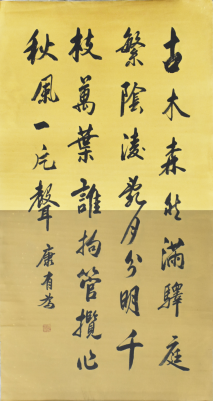
从形制与书体维度审视,这幅作品尽显“雄强开张、大气磅礴”的康氏书风特质。作品以泥金笺为载体,取四列竖排布局,字径硕大、行气贯通,既延续了清代大字书法“重气势、讲格局”的创作传统,又以碑学笔法重构行书形态,将行书的灵动与魏碑的雄强完美融合;书体上以行书为形、魏碑为骨,结体宽博开张、笔画沉雄厚重,一改传统帖学行书的秀逸纤巧,尽显“康体”书法“纵横开张、气势撼人”的鲜明特征。每一字的结体、每一行的行气,都凝聚着对晚清碑学革新理念的精准表达,成为解析近代书法转型的物质纽带。
From the perspective of form and calligraphy style, this work fully demonstrates the characteristic of Kang's calligraphy style of "vigorous, open and magnificent". The work takes gold-flecked paper as the carrier, adopts a four-column vertical layout, with large character size and connected momentum. It not only inherits the creative tradition of "emphasizing momentum and pattern" in large-character calligraphy of the Qing Dynasty but also reconstructs the runningscript form with stele brushwork, perfectly integrating the flexibility of running script and the vigor of Northern Wei stele; in terms of calligraphy style, it takes running script as the form and Northern Wei stele as the framework, with broad and open structure and vigorous and heavy strokes, changing the elegant and delicate style of traditional post running script, fully showing the distinctive feature of "Kang-style" calligraphy of "vertical and horizontal opening, impressive momentum". The structure of each character and the momentum of each line condense the precise expression of the late Qing stele reform concept, becoming a material link for analyzing the transformation of modern calligraphy.
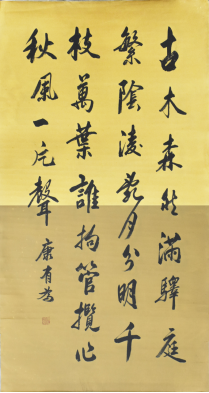
笔墨与技法层面,这幅作品承载着“碑学为骨、行书为魂、革新为韵”的创作追求。其笔墨语言极具康氏个人风格:以圆笔中锋入纸,笔画沉雄浑厚、力透纸背,兼具魏碑的方劲与行书的灵动,尽显“万毫齐力”的笔墨张力;以浓墨书写,墨色饱满沉郁、干湿相生,在泥金笺的暖黄底色上形成强烈视觉对比,既保留了传统书法的笔墨韵味,又凸显了碑学书法的雄强气势。尤为精妙的是,作品融魏碑的方整、隶书的波磔与行书的流畅于一体,结体上紧下松、左低右高,笔画间穿插避让、顾盼生姿,与康有为《广艺舟双楫》中“尊碑、备魏、取隋、卑唐”的书学主张一脉相承。作品落款“康有为”,并钤盖名章,是康氏书法“诗书画印”一体的典型范例。每一处笔墨的提按顿挫、每一字的结体开合,都在无声诉说着康有为对碑学革新的极致践行,使作品既具视觉的震撼力,更显近代书法的革新精神。
In terms of brushwork and technique, this work embodies the creative pursuit of "stele studies as the framework, running script as the soul, and reform as the charm". Its brushwork language is highly personal to Kang: entering the paper with round brush and central stroke, the strokes are vigorous, thick and forceful, combining the square strength of Northern Wei stele and the flexibility of running script, fully showing the ink tension of "all hairs exerting force"; writing with thick ink, the ink color is full, deep, with a combination of wet and dry, forming a strong visual contrast on the warm yellow background of gold-flecked paper, which not only retains the ink charm of traditional calligraphy but also highlights the vigorous momentum of stele calligraphy. What is particularly exquisite is that the work integrates the square of Northern Wei stele, the wave of clerical script and the fluency of running script, with a tight upper part and loose lower part, low left and high right in structure, and interspersed and avoided strokes, which is in line with Kang Youwei's calligraphy proposition of "respecting steles, preparing Wei, taking Sui, and belittling Tang" in Guangyi Zhou Shuangji. The inscription "Kang Youwei" at the end of the work, with a name seal stamped, is a typical example of the integration of "poetry, calligraphy, painting and seal" in Kang's calligraphy. Every lifting, pressing, pausing and turning of the brushwork, and every opening and closing of the character structure silently tells Kang Youwei's ultimate practice of stele reform, making the work not only have visual impact but also show the reform spirit of modern calligraphy.
文化价值与时代意义维度看,这幅康有为款行书作品是晚清碑学革新运动的“微观镜像”。晚清时期是中国书法史的重大转型阶段,以康有为为代表的碑学流派,打破了千年帖学的垄断,倡导“尊碑抑帖”,推动书法向雄强、开张的风格转型,这幅作品便是这一文化潮流的典型样本——它既保留了传统行书的书写意趣,又以碑学笔法彰显了晚清士大夫“救亡图存、革新求变”的精神内核,是“中华书法从帖学传统到碑学革新”转型的直观体现。在当代书法语境下,它不仅是一幅书法作品,更是解析晚清书法史、思想史的关键标本:其价值不仅在于笔墨的精湛与风格的雄强,更在于它所承载的“晚清碑学革新文化记忆”,每一笔的沉雄、每一字的开张,都在诉说着中国书法从古代到近代的风格演变,成为连接晚清书法革新与当代书法创作的精神纽带。此外,康有为的传世书法作品存世量虽不算稀少,但这类兼具笔墨功力与文化内涵的精品,更成为近代书法收藏领域的珍贵瑰宝,其历史与艺术价值均不可估量。
From the perspective of cultural value and epochal significance, this running script work attributed to Kang Youwei is a "micro mirror" of the late Qing stele reform movement. The late Qing Dynasty was a major transitional stage in the history of Chinese calligraphy. The stele school represented by Kang Youwei broke the millennium-long monopoly of post studies, advocated "respecting steles and restraining posts", and promoted the transformation of calligraphy to a vigorous and open style. This work is a typical sample of this cultural trend—it not only retains the writing interest of traditional running script but also highlights the spiritual core of late Qing literati "saving the nation from subjugation and seeking reform" with stele brushwork, which is an intuitive embodiment of "the transformation of Chinese calligraphy from post tradition to stele reform". In the context of contemporary calligraphy, it is not only a calligraphy work but also a key specimen for analyzing the history of late Qing calligraphy and thought: its value lies not only in the exquisite brushwork and vigorous style but also in the "late Qing stele reform cultural memory" it carries. The vigor of each stroke and the opening of each character tell the stylistic evolution of Chinese calligraphy from ancient to modern times, becoming a spiritual link connecting late Qing calligraphy reform and contemporary calligraphy creation. In addition, although the number of surviving calligraphy works by Kang Youwei is not rare, such fine works with both brushwork skill and cultural connotation have become precious treasures in the field of modern calligraphy collection, with immeasurable historical and artistic value.
当我们凝视这幅康有为款行书作品,沉雄的笔墨与开张的结体在眼前交融,晚清碑学的革新精神与士大夫的家国情怀在方寸间碰撞,仿佛能触摸到康有为“公车上书”的家国担当、《广艺舟双楫》的书学革新,也能感受到中华书法“以笔载道、以书立心”的深厚底蕴。它不仅是一幅近代行书作品,更是晚清碑学革新的艺术结晶、近代士大夫精神的物质凝结,在时光的摩挲中静静散发着书法的古韵,以其独特的风格与文化内涵,让每一位观者都能读懂这份藏在笔墨里的晚清风骨,感受那份融于笔端的革新精神与家国情怀。
When we gaze at this running script work attributed to Kang Youwei, the vigorous brushstrokes and open structure blend before our eyes, and the reform spirit of late Qing stele studies and the family and country feelings of literati collide in a small space. It is as if we can touch Kang Youwei's family and country responsibility in the "Public Vehicle Petition" and the calligraphy reform in Guangyi Zhou Shuangji, and feel the profound heritage of Chinese calligraphy of "carrying the Dao with brush, establishing the heart with calligraphy". It is not only a modern running script work but also an artistic crystallization of late Qing stele reform and a material condensation of the spirit of modern literati, quietly exuding the ancient charm of calligraphy in the touch of time. With its unique style and cultural connotation, it allows every viewer to understand the late Qing integrity hidden in the brush and ink, and feel the reform spirit and family and country feelings integrated into the brush.

猜你喜欢

遂宁构建“工会+邮储+邮政”三位一体普惠服务新模式
 190
智邦国际新一代一体化ERP销量稳健增长,“数智”赋能中国企业新质破局
168 "暖阳青稞"债券回购在即 市场认购热情持续升温
199 跨越小哥以专业服务铸就物流品质标杆
143 欢迎走进《丰华悦动》——运动行业的全新线上创富平台
112 泰普尔携全系新品亮相2025CIFF中国家博会 以智能睡眠系统引领行业风尚
127 ChordCraft荣获重要认可:推动全球音乐教育的数字化革新
129 重磅!餐饮品牌设计排名top10公司发布!
137 新时代艺术家——黄汉羽
162 深圳跨越速运集团有限公司,让企业告别物流等待
188